

When Youth Imprisons and Age Sets Women Free:
A Life-Course Critique of Patriarchy

Sameer Ahmad
Across cultures, a woman’s youth is often seen as the most beautiful, valuable, and promising phase of her life. Popular culture, family structures, and economic systems consistently portray youth as a woman’s greatest asset. Yet there is a troubling reality: youth is also the period when women are most controlled, monitored, and disciplined. Young girls are pressured to remain pure, respectful, and obedient. Freedom becomes distorted, as protection turns into restriction and care becomes surveillance.
In contrast, aging is often viewed negatively—associated with the loss of beauty, social relevance, and value. Yet paradoxically, growing older can grant women a measure of freedom and the ability to move beyond rigid social expectations. Drawing from our field experience, we explore this contradiction: in many patriarchal systems, youth functions as confinement, while aging opens limited possibilities.
This picture was captured on a field experience from a research trip to Jaithpur village in UP, and it contextualises an individual story within the socio-cultural, caste, and gender systems of power. An elderly Dalit woman’s life story illustrates how power operates throughout the female life cycle, how the exercise of control over women’s lives is postponed rather than absent, and how the neglect directed towards women is converted by women into an exercise of powerful agency.
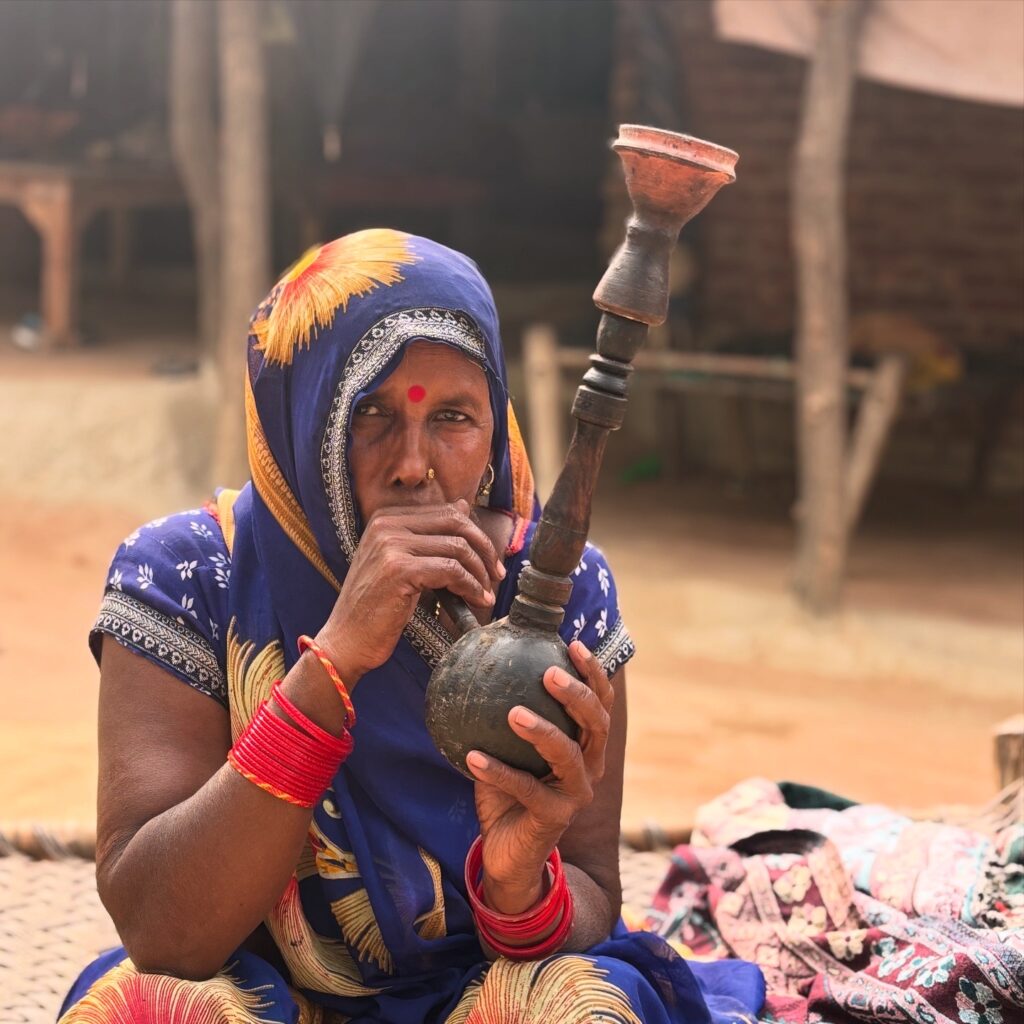
During our research stay in Jaithpur village in Raebareli district of Uttar Pradesh with the research firm Datum Works, we encountered an image that disrupted conventional ideas of age, power, and freedom. Sitting in an open courtyard was an elderly Dalit woman in a relaxed yet commanding posture. Her scarf was tightly tied, red bangles circled her wrists, and a hookah rested between her lips. There was no hesitation in her movements. She occupied space with quiet authority
Our immediate reaction revealed our own social conditioning. We subconsciously associated her posture and confidence with masculinity. When we complimented her on her openness and freedom, she did not celebrate it. Instead, she reflected on it. This freedom, she explained, was not lifelong. It had been earned late and at a high cost.
During our conversation, she shared that her youth had been defined by restriction. Protection and morality built invisible walls around her life. She could not move freely, speak openly, or question authority. Her body symbolised family honour. Her dreams were never nurtured.
She was not only a woman but a Dalit woman. Her labour sustained both home and fields, yet her contribution was undervalued. Privileged-caste women face control in the name of honour and purity, but Dalit women face layered oppression, economic exploitation, caste discrimination, and gendered expectations. Patriarchy and caste work together to silence them.
Repeatedly, she was reminded that a woman’s duty was confined to domestic service. Speaking up invited scolding; questioning invited punishment. Youth, for her, did not mean vitality. it meant survival. Her presence was monitored, her actions regulated, her aspirations diminished.
With age, however, something shifted. Surveillance weakened. Her body was no longer central to anxieties about sexuality or reproduction. Society no longer saw her as a “risk.” Ironically, this indifference created space. Expectations softened. Silence gave way to speech. The courtyard that once symbolized confinement became a site of expression.
The same people who once ignored her voice began seeking her opinion. Years of labor and hardship gave her words weight. Experience transformed into authority.
Not only are people able to move more as they get older, but they also get to say what they think. It is the same people in her life who did not pay much attention to what she had to say when she was younger than now ask what her opinion is. The experience she gained from working and living through hard times made what she had to say important. What she has to say means a lot because she has been through a lot, and people know this.
Her story forces us to rethink strength and independence. If freedom comes only with age, what does that reveal about systems meant to protect women? Why must women wait until youth fades to make their own decisions? Society values young women, yet denies them autonomy. When women grow older, society cares less—but also controls less. This is patriarchy’s contradiction.
Liberation, here, is not linear. It is delayed and uneven. It emerges not from recognition or rights, but from endurance. This is deeply unjust. No woman should have to wait decades for autonomy.
This freedom carries bitterness. It reflects not success, but the failure to grant women independence when they needed it most. Her life reminds us that while patriarchy may loosen its grip with age, true justice means women should never have to wait to be free.
“Youth imprisoned her in the name of protection, and age released her through indifference. This is the cruel paradox of patriarchy.”
Datum Works

2 Comments
A really good blog and me back again.
每天都在战争,希望2026和平.